
Deconstructing "We Never Know What People Are Going Through"

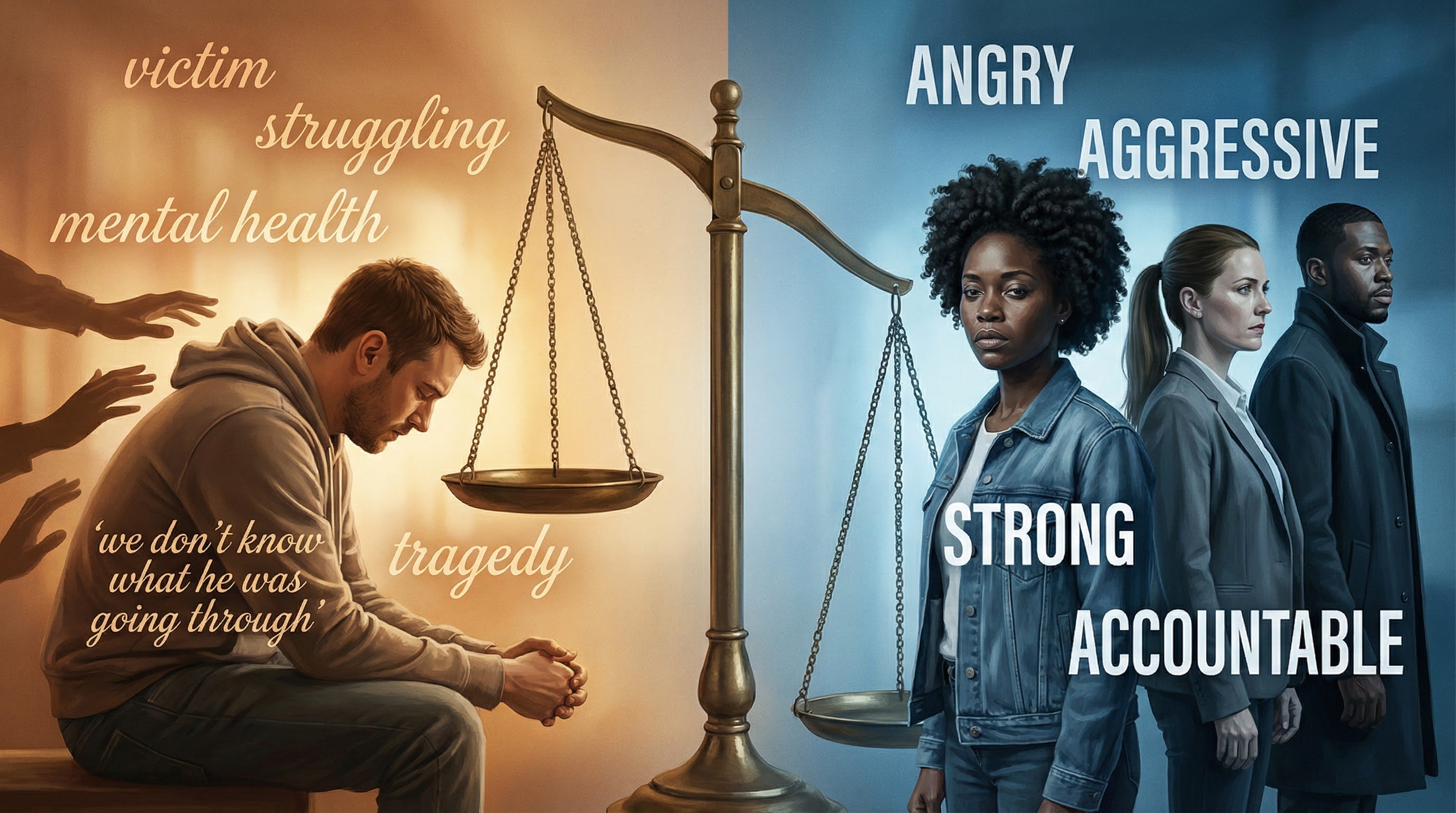
The phrase, “we never know what people are going through,” is often deployed as a gesture of empathy, a soft-spoken reminder to reserve judgment. It suggests a world of hidden struggles and unseen burdens, urging compassion over condemnation. However, when applied in the context of violence, this seemingly benevolent sentiment transforms into a dangerous tool of normalization and deflection. It functions as a soft way of excusing violent acts, particularly those committed by men, while simultaneously reinforcing a cruel double standard that denies the same grace to women, especially Black women. By attributing violence to ambiguous personal struggles or mental illness, we not only soften the horrific reality of the acts themselves but also perpetuate a system where accountability is selectively applied along gendered and racialized lines.
As a Black mental health nurse, I have witnessed this dynamic play out in both professional and personal contexts. In my clinical practice, I have worked with countless individuals who live with serious mental illness—depression, bipolar disorder, schizophrenia, and more. The overwhelming majority of these patients are not violent. They are struggling, yes, but their struggles manifest in withdrawal, in despair, in the quiet devastation of trying to navigate a world that often misunderstands them. Yet when violence occurs in our communities, particularly when the perpetrator is a man, the immediate public reflex is to invoke mental illness as the explanation. This reflexive attribution does a profound disservice to my patients and to the broader mental health community, painting them with a brush of dangerousness that research consistently refutes.
This deflection is most readily apparent in the immediate and often incorrect leap to connect violence with mental illness. While the public consciousness, often shaped by media narratives, is quick to label violent perpetrators as “mentally ill,” research consistently debunks this as a primary causal link. Data from the American Psychological Association (APA) and other extensive studies show that the vast majority of people with mental health conditions are not violent; in fact, they are more likely to be the victims of violence than perpetrators [1]. Studies indicate that individuals with serious mental illness contribute to only 3-5% of all violent acts [2]. The MacArthur Violence Risk Assessment Study, a landmark in the field, found that environmental and historical factors—such as living in a high-crime neighborhood, a history of substance abuse, or experiencing childhood abuse—are far more predictive of violence than a psychiatric diagnosis alone. When patients discharged from psychiatric facilities were compared to their neighbors without mental illness, their rates of violence were roughly the same, underscoring that “a great deal of what is responsible for violence among people with mental illness may be the same factors that are responsible for violence among people without mental illness” [1]. By using mental illness as a catch-all explanation, we unfairly stigmatize a vulnerable population and, more dangerously, create a convenient off-ramp for holding violent individuals accountable for their choices.
In my years of practice, I have observed how this misattribution functions in real time. When a patient with a documented mental health condition exhibits aggression, the clinical team conducts a thorough assessment: What are the environmental triggers? Is there substance use involved? What is the patient’s history of trauma? We understand that mental illness alone does not cause violence; it is the constellation of factors—poverty, victimization, lack of support, substance abuse—that increases risk. Yet when a man commits an act of violence in the broader community, this nuanced understanding evaporates. The conversation becomes reductive: he must have been mentally ill, he must have been “going through something.” This is not clinical reasoning; it is cultural excuse-making.
This misattribution of violence is not applied evenly. It is a grace disproportionately extended to male perpetrators, often amplified when the perpetrator is white. A recent murder-suicide in Bibb County, Georgia, serves as a chilling case study. In February 2026, 51-year-old Ray Summers, while being served an eviction notice, shot and killed his 49-year-old wife, Brande, their 21-year-old daughter, Haliegh, and the family pets before taking his own life [3]. News reports immediately framed the event around the eviction, presenting the perpetrator’s financial stress as the implicit catalyst. Neighbors described the event as a “horrible tragedy” that was “hard to process” [4]. While undeniably tragic, this narrative focus subtly shifts the lens of sympathy toward the perpetrator’s circumstances. The conversation becomes about his desperation, his financial woes, his state of mind. The victims, his wife and daughter, are rendered secondary to the narrative of his struggle. This is the phrase—”we never know what people are going through”—in action. It centers the man’s experience and uses his external pressures as a de facto excuse for committing intimate partner and family violence, effectively erasing his agency and accountability.
I have seen this pattern repeatedly, both in the news and in my professional life. When a man commits violence, the immediate response is to search for reasons, to humanize him, to understand what drove him to such an act. But when a woman, particularly a Black woman, exhibits any form of anger or self-defense, she is not afforded that same curiosity. She is simply labeled as aggressive, as dangerous, as the problem itself.
A 2018 study from Ohio State University provides empirical evidence of this racialized and gendered sympathy, finding that media coverage of mass shootings treats white perpetrators far more sympathetically than Black perpetrators. The study, which analyzed hundreds of articles, found that white shooters were 95% more likely to be described as “mentally ill” [5].
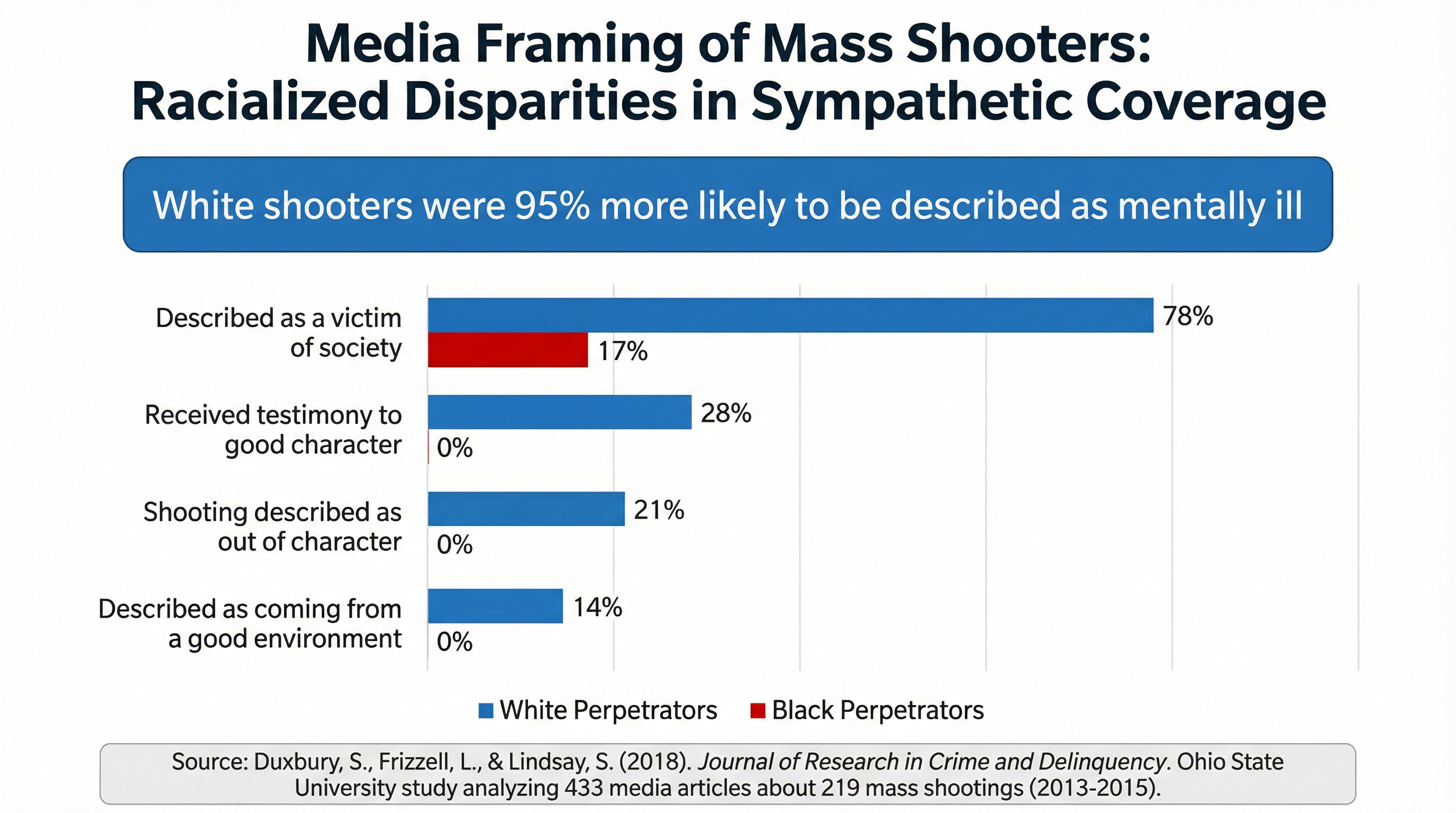
The researchers highlighted the starkly different portrayals of two men who committed similar crimes: Josh Boren, a white man who murdered his family, was described as a “quiet, gentle man,” while David Ray Conley, a Black man who also murdered his family, was framed as “perpetually violent, controlling and dangerous” [5]. This demonstrates a clear societal pattern: the benefit of the doubt, the sympathetic inquiry into “what they were going through,” is a privilege overwhelmingly reserved for white men.
Conversely, this grace is systematically denied to women, and most acutely to Black women. When a Black woman is a perpetrator of violence, often in self-defense against an abuser, the narrative of sympathy evaporates. She is not seen as someone who was “going through something”; she is seen as a criminal. The cultural stereotypes of the “Angry Black Woman” and the “Strong Black Woman” converge to create a uniquely perilous position. The “Angry Black Woman” trope pre-judges her as inherently aggressive and irrational, making it difficult for her to be perceived as a legitimate victim or as someone acting out of desperation or fear [6]. Simultaneously, the “Strong Black Woman” trope suggests an infinite capacity for resilience and endurance, stripping her of her vulnerability and the right to be protected [7].
As a Black woman working in mental health, I have felt the weight of these stereotypes in my own life. I have watched Black women patients in crisis be treated with suspicion rather than concern, their pain interpreted as aggression, their pleas for help dismissed as manipulation. I have seen Black women who defended themselves against abusers be criminalized, while their abusers—often men—are granted the benefit of context, of understanding, of the assumption that they, too, were victims of circumstance. The system does not pause to ask what she was going through; it simply punishes.
This dynamic results in what Amber Simmons of the Harvard BlackLetter Law Journal calls the “legal invisibility” of Black women as victims of domestic violence [6]. They are held to an impossible standard of accountability that their male, and especially white male, counterparts are not. While a man who kills his family over an eviction is framed as a tragic figure pushed to the brink, a Black woman who defends herself against her abuser is often criminalized and incarcerated. The system does not pause to ask what she was going through; it simply punishes.
Professionally, I have dedicated my career to understanding the complexities of mental health and the factors that contribute to both suffering and healing. I know intimately that mental illness is not a predictor of violence, and that the vast majority of people living with mental health conditions are navigating their lives with dignity and courage. Personally, as a Black woman, I have lived the reality of being denied grace, of being expected to endure without complaint, of watching men—particularly white men—be afforded endless understanding while women like me are held to impossible standards of strength and silence.
To continue offering the hollow sympathy of “we never know what people are going through” in the face of violence is to be complicit in the normalization of that violence. It is a phrase that has been weaponized to uphold a patriarchal and racist hierarchy of victimhood. It excuses the inexcusable and deflects from the difficult but necessary work of demanding accountability. True empathy does not lie in manufacturing excuses for perpetrators; it lies in centering the victims, acknowledging the horror of the violence inflicted upon them, and dismantling the unjust systems that decide whose pain is worthy of understanding and whose is not.
References
[2] Georgetown University. (2015). Debunking Myths about Gun Violence and Mental Health.
I have found that when people say” we never knew what they were going through” they feel that it absolves them of any type of personal responsibility. We all have choices that we make on any given day. If you care about someone you ask, you inquire, you talk to them. When you truly have compassion you take the time to ask someone how they are and truly mean it. It saddens me that the majority of people would rather give excuses than to be honest. Honesty uncovers what is always hidden beneath the surface and sometimes people don't want you to know what they really feel or think.
Dr Jessica Taylor backs up your trustworthy knowledge in general for women, although she regretfully doesn't specify the particular conditions for black women:
https://whatwouldjesssay.substack.com/p/day-13-stop-saying-your-abuser-has